
LED solutions power commercial lighting across stadiums, malls, and public infrastructure with programmable illumination, precise color rendering, and networked controls LED screen display. Systems support zoned dimming, scene scheduling, and fault diagnostics to reduce energy use and maintenance. In retail, controlled luminance and accurate chromaticity optimize merchandising and wayfinding. Public projects emphasize efficacy, longevity, and emergency-ready, battery-backed units. Open APIs and modular hardware guarantee interoperability and upgradeability. Continue for detailed standards, control strategies, and procurement guidance.

Stadiums: Enhancing Fan Experience and Operational Efficiency
In large-scale sports and entertainment venues, LED lighting systems are deployed to optimize visual performance, energy consumption, and operational control. The design integrates dynamic signage with immersive audio visual arrays to guide spectators, broadcast information, and create programmable atmospheres. Systems conform to lumen, color-rendering, and flicker standards while enabling adaptive coloration for branding or safety cues. Networked controllers provide zoned dimming, fault diagnostics, and schedule-driven scenes, reducing operating costs and maintenance intervals. Data from crowd analytics feeds lighting and signage logic to improve circulation, ingress/egress timing, and emergency response coordination without compromising spectator autonomy. Procurement and installation follow interoperability protocols and open APIs, allowing operators to select vendors and customize systems that preserve flexibility and long-term upgradeability.
Malls and Retail: Visual Merchandising and Wayfinding With LEDS
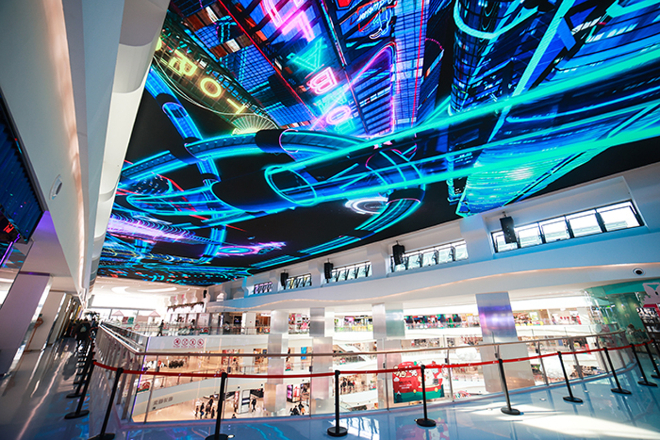
Within mall and retail environments, LED systems serve dual roles of visual merchandising and wayfinding by delivering controlled luminance, accurate color rendering, and programmable signage to guide shoppers and enhance product presentation. The technology enables precise illumination of window displays, creating focal planes and contrast ratios that direct attention without overexposure. Color accents are specified to match brand palettes, supporting consistent perception across fixtures and digital displays. Modular LED modules and linear systems integrate with rigid mounting standards for repeatable installation and maintenance. Signage employs high-contrast alphanumerics and directional cues tested against legibility metrics to reduce cognitive load. Deployment guidelines prioritize uniformity, maintenance access, and photometric documentation. Resultant environments balance aesthetic freedom for retailers with reproducible performance and measurable wayfinding effectiveness.
Infrastructure and Public Spaces: Safety, Energy Savings, and Smart Controls
For public infrastructure and shared spaces, LED systems provide standardized illumination that enhances safety, reduces energy consumption, and enables networked control strategies. Specifications emphasize luminous efficacy, color rendering, and longevity to meet municipal performance standards. Integrated controls support adaptive dimming, daylight harvesting, and motion-based responses to optimize energy use while preserving visibility. Traffic signaling adopts LEDs for rapid response, precise chromaticity, and lower maintenance cycles, improving intersection throughput and compliance. Emergency lighting leverages battery-backed LED units with self-testing and remote diagnostics to guarantee code compliance and occupant egress reliability. Open protocols and modular hardware permit vendor interoperability and user autonomy in configuration. Lifecycle assessment and predictive maintenance frameworks inform procurement, minimizing total cost of ownership and maximizing public benefit.
Frequently Asked Questions
How Do LEDS Impact Acoustics in Enclosed Venues?
LED fixtures minimally affect venue acoustics; they introduce negligible thermal noise but add reflective surfaces and potential scattering points, altering reverberation patterns. Proper fixture selection and placement preserves acoustic standards while permitting lighting flexibility and occupant autonomy.
Can LED Lighting Be Recycled or Sustainably Disposed?
Yes. LEDs generally support end of life recycling; components (metals, PCBs, heat sinks) are recoverable. Proper protocols guarantee mercury free disposal and compliance with standards, enabling responsible material recovery and user autonomy.
Do LEDS Interfere With Wireless Communication Systems?
Yes. It states LEDs can affect wireless systems through signal reflections and photoelectric interference; proper shielding, spectral filtering, and adherence to emissions standards minimize impact, preserving system autonomy while enabling compliant, interoperable deployment.
What Are Long-Term Maintenance Costs Compared to Traditional Lighting?
LED systems yield lower long-term maintenance costs: operational savings from reduced energy and replacement frequency, while fixture longevity minimizes labor and inventory. Standards-driven planning confirms lower total cost of ownership versus traditional lighting over lifecycle.
Can LEDS Be Integrated With Emergency Broadcast Systems?
Yes. LED integration with Emergency alerts is feasible: fixtures support networked controls, standardized protocols (e.g., DALI, BACnet), secure gateways, and priority messaging. Implementation requires redundancy, testing, certification, and clear operational authority for liberated responders.
Conclusion
LED lighting delivers measurable performance benefits across stadiums, malls, and public infrastructure by combining high luminous efficacy, long service life, and controllable output. Standardized fixtures and protocols enable reliable color rendering, dimming, and networked control for wayfinding, safety, and dynamic signage while reducing maintenance and energy load. Adoption of LED systems supports compliance with lighting and energy standards, facilitates integration with smart-building platforms, and yields predictable operational savings and enhanced user experience over incumbent technologies.


